
The Face of Lent

Crazy Stable, it's been awhile. The blinding midway of the Interwebs, the Buzzing Feeds and Huffing Pos, the klouts and tweets and trending, can drain the impulse power of the thoughtful blogger. It used to feel fresh and immediate to post several times a week, and the prose felt nice and trim at a dozen grafs or less. Now one feels like a monk in a Scriptorium doing that, and not in a good way.
So naturally, I decided to revive the dormant blog with a Lenten retreat about the Holy Face, and start with Lambchop and Noel Fielding.
I am obsessed with the Holy Face. Well, I am obsessed with the Holy Shroud of Turin, and that leads to a thing for the Holy Face. Hardly original, I know; museums and books overflow with artists' renderings. But it gets me—if Jesus was God, then God had a human face. For someone as theologically impaired as I am, this is hugely compelling. I can't fathom Aquinas, I can't concentrate on the Rosary for more than a few beads...but I can look for a face in the crowd.  So for each day of Lent, I will post something about the Face. I'm easing in with this quote from surrealist comic Noel Fielding; it's a warm-up line he uses in his indescribable stand-up gigs. Delivered in his adorable British accent, (usually after having called his audience "cheeky otters"), it only seems to mean nothing. But it strikes me as touching and profound, a daring declation of human solidarity and vulnerability. (Which stand-up is.) I decided to let Lamb Chop deliver the line because she, too, has a face, and a fine one.
And if everyone's off Travoltifying their name or checking in on Grumpy Cat, I will enjoy hanging out with some hardcore Catholic geekery all by myself. My blog's still ad-free, so I don't have to say things like THEY TOOK A PICTURE OF THIS BLOODY SHEET...AND YOU WON'T BELIEVE WHAT HAPPENED NEXT.
Or you could join me; I guarantee we won't be trending.

 Brenda from Brooklyn
in Holy Face, Holy Shroud, Lambchop, Noel Fielding
|
Brenda from Brooklyn
in Holy Face, Holy Shroud, Lambchop, Noel Fielding
|
 Post a Comment
MOSER/BECKER HEART BOOK REHABILITATED
'Not So Bad After All,'
Says Co-Author 20 Years Later
 [Not the New York Times, May 22, 2013] Trendy claims may sell books, but when it comes to medical advice, boring may be beautiful, according to Brenda L. Becker, the persistently obscure co-author of Week by Week to a Strong Heart. The book, which the perennially unknown medical writer ghost-wrote 20 years ago with Yale University hypertension authority Marvin Moser, MD, remains best known in her mind for its rock-bottom production values (thanks to a shoestring budget by Rodale Book Club, its publisher) and for Moser's insistence on maddeningly cautious medical advice at a time when oat-bran books and Dean Ornish's guru-like prescriptions for meditation and vegetarianism dominated the health best-seller lists and enriched their authors.
Published in 1992, well past the height of the public's first wave of obsession with cholesterol and heart disease and just before the statin era began, "Week by Week" sank out of sight after its brief book-club life span expired—although, Becker recalls, Moser never stopped believing that some day the public would tire of "miracle cures" and flock to their common-sense plan for gradually healthier habits. In the ensuing decades, she admits, she came to dismiss the book as a dated hack job, one that eventually yielded her "somewhere in the low three figures" in royalties. Now, however, upon rereading one of her several author copies (stockpiled once friends began refusing to take the extras, even as gifts), Becker acknowledges that her co-author may have been prophetic in his insistence on affordable, low-tech health interventions and incremental change.
Nor is the book as dated as she had feared, Becker adds, although Moser's rather laid-back approach to cholesterol risk has been replaced by aggressive prescribing. (Maybe too aggressive, according to a trickle of new safety signals about statins.) Countless other new medications have been introduced, of course, and some aspects of cardiology, such as understanding of the mechanisms underlying atherosclerosis and metabolic syndrome, have advanced greatly. The obesity epidemic has exploded since the book's publication, along with drastic measures such as Lap-Band procedures. But the book’s premise remains remarkably sound, if spectacularly uncommercial: Common-sense, simple improvements in diet, exercise, and risk-factor control can save your life.
 Certainly, the book’s primary author would seem to be a good advertisement for his own advice. Becker, who has not been in touch with Moser for most of the years since its publication, recently “Googled” him, expecting to find a respectful obituary for a clinician and researcher old enough to remember Franklin D. Roosevelt’s death by malignant hypertension—or at least to read news of a retirement crowned with professional laurels. She was astonished to discover that Moser, now 87, is not only still alive and honored with a named award by the American Society of Hypertension, but still actively teaching at Yale. His familiar, George Bush the Elder-sounding voice invites callers to leave a message with easy, Locust-Valley lockjaw authority that Becker remembered well from marathon editing sessions. She recalled that Moser, for all his high-profile schedule as a hypertension talking-head and his relentless presence at prestigious medical meetings, was first and always a compassionate and practical advocate for his patients. And, while Becker ghosted much of the text, he did pen its best line: "I have reversed cardiac arrest with a chest thump on two occasions, once on a tennis court and once on an airplane."
Becker, no spring chicken herself, has recently been put on a high dose of an expensive new statin for her high cholesterol; the drug, she says, has left her with muscle cramps and weakness. Having reread the book and been surprised by its evergreen (if totally unheralded and unremunerated) wisdom, she left a message for Moser and got a prompt callback. His advice: Try a cheaper generic like simvastatin. "It's a little less effective, but take a few milligrams more." His other advice: Let's get somebody to re-issue the book!
Meanwhile, Becker recommends snapping up a rare copy of the original, which can be found on Amazon and other outlets starting at $.01...plus shipping. Do it for yourself, not for her; she hasn't gotten a royalty check since the George H.W. Bush administration.
Brenda from Brooklyn
in " cholesterol, "Week by Week to a Strong Heart, Marvin Moser
|
1 Comment
Happy and peppy and bursting with love

That great old tune by Felix Unger could be the theme song of the literary moment (rather than, one hopes, a full-fledged movement) known as "Chick Lit." Now, in hopes of luring in the ladies, such Debbie-Downer gal scribblers as Sylvia Plath are getting the lipstick makeover. (Hey, Emily Bronte is now being sold as "Bella and Edward's favorite writer." Don't believe me? Go here.)
It's been awhile since I put off real work by whipping up some book covers; last time, I gave some classics the self-pub treatment (another moment we're totally into). Now it's time to brighten up some prestige-laden sob sisters with the cover treatment that says This book is good. Shoe-shoppin' good.

Let's start with that dour classic that launched a thousand Women's Studies' reading lists.

Overshare memoirs are big with the ladies; just ask Carrie Bradshaw!

More memoirs; let's put the "ditz" in dysfunctional!

Hey, admit it: "Feminist dystopian novel" just doesn't have that fly-off-the-shelves ring, now, does it?

It's such a cute book, she and her sister are, like, always writing to each other about guys and stuff.

Okay, I know. I will rot in hell for this. Happy reading, girls; I'll get the cupcakes, and I'll see you at Book Club!
The mercy of the court

This little boy is named Derby. He and his twin Loen were born at 24 weeks’ gestational age. Today, they are happy and reasonably healthy 5-year-olds whose story is recounted here.
Forty years ago, the Supreme Court of the United States of America made it legal in all 50 states to kill a child of this age, if he or she is still inside the womb.
About 1,000 children* this size are legally killed each year. Fifty Sandy Hooks a year. Not by guns, but by medical professionals. Since Roe v Wade, that equals 40,000 babies as indisputably alive and human as the one in this photograph, destroyed using techniques too disturbing to describe here.
Why focus on such a tiny percentage of the total number of abortions performed each year since Roe?
One reason is because later-term unborn babies are more immediately recognizable as ourselves, and we are more readily moved to defend that which we recognize.
Another reason is that I cannot wrap my mind around numbers like 54 million, a conservative estimate of the number of missing children since the "right to privacy" denied them their most fundamental human right: the right to live.
To talk about "social justice" but turn away from this truth...how?
 Derby and Loen, born at 24 weeks' gestation, young enough to have been legally aborted in the U.S."We shall not weary, we shall not rest, until every young woman is given the help she needs to recognize the problem of pregnancy as the gift of life. We shall not weary, we shall not rest, as we stand guard at the entrance gates and the exit gates of life, and at every step along way of life, bearing witness in word and deed to the dignity of the human person—of every human person."--Richard John Neuhaus, 2008
*According to a 1997 survey by the Guttmacher Institute, more than 1,000 babies 24 weeks' gestational age or older are aborted each year in the U.S. According to the CDC, about 1% of all abortions in 2009 took place after 21 weeks' gestation, which would equal at least 7,000 a year. According to another Guttmacher survey, a fetal problem was present in only 2% of such abortions.
Losing Coco
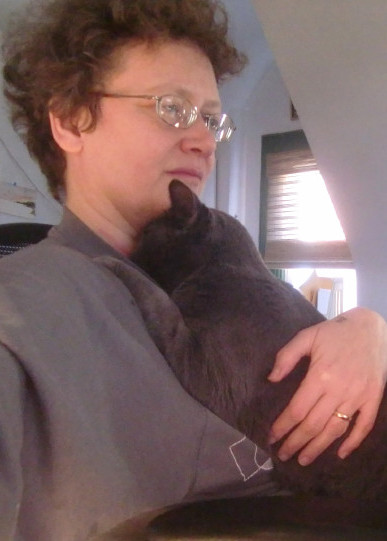
This is how I've spent at least a part of each day for precisely the past 10 years. This is Cocobop (as in "Shimmy, shimmy"), and he is a "wool sucker," only the "wool" is me. (And, once and to his shame, the wool was a tech support guy in the same chair.) Supposedly, wool-sucking is a misdirected nursing behavior; the cat kneads and derives some presumed psychic "milk" from soft surfaces like blankets or sweaters. Coco likes certain velour throws and especially, a hot-pink fuzzy bathrobe, but mostly he likes my neck. Around here we just call it "neck-sucking." It involves a lot of purring and tenderizing with claws, and I have learned to tolerate it and even be oddly honored by it.
I also have endured it because Coco is a foolish and simple cat who has never asked for much besides bottomless food dishes and prodigious amounts of sleep, plus the occasional sunbeam. At my desk, our dance would begin with a plucking of my arm; there would be that owlish face, all needy eyes and glossy grey fur. He is the original "50 shades of grey," from mauve-tinted dove to deep slate; his fur seems to refract light, especially blue. Put him near something blue and he becomes blue.
 Lilo and Stitch, 2002Next would come the stomp across the keyboard and up my chest. The first time we laid eyes on him, at the chaotic grim shelter of the CACC in East New York, he was a youngster of 5 months or so; he shot out of the cage and fastened on my neck and nursed for dear life. I handed him to Daughter, who was 7, and he did the same to her; the bond was sealed. No other kitten had a chance. I called them "Lilo and Stitch."
 The Pride: Lexi (brown), Cocobop (gray), Charlie (gold)Neck-sucking isn't Coco's only passion; he enjoys destroying table legs and leather goods to wear down his fine, opalescent claws. He loves a good 8-hour power nap. And he has been an affectionate "sibling" to Lexi, the portly diva, and Charlie, the feisty baby of the pride. But it has always come back to cat-on-human contact. With Daughter, it was a delicate lick on the face or hairline when she'd come home from school; with me, the neck thing. I love the fact that Coco responds physically to verbal endearments; if I would call him "Pretty Cocobop," with a gentle puff on the Ps and Bs, he would audibly intensify his purr and knead harder.
 The fatuous 'Blue Steel' lookFour days ago, his golden eyes filled up with gunk and he suddenly stopped eating. I figured, virus; the kind folks at Hope Veterinary found a golfball-sized mass, probably lymphoma. Cat chemo can buy you 6 more months or so, but Cocobop has turned inward and shut down on us. We have lost many cats to cancer over the years, and whether the end comes suddenly or slowly, it always comes with dignity. They tell you when it's time.
A week ago, suffering from a back spasm, I slept in our upstairs guest room for its firmer mattress. As I lay face-down, seeking the fragile spaces without pain, Coco (still seemingly in perfect health) walked onto my back and began to knead. Cat-shiatsu: the delicate claw-pricks seemed to draw energy away from the lumbar storm. And then he curled up next to my face and kept vigil, thrilled that I had joined him in one of his favorite haunts. I felt suffused with unearned grace.
 Last night, when he finally emerged from his carrier, sedated after a needle-aspiration biopsy, he skulked upstairs to the same bed to snooze in the dark. I slipped in beside him, very quietly; he started to leave, then resignedly lay back down, then drew closer. No neck-sucking, but he had some intense moments with the plush blanket I pulled around me as the night grew chill. I whispered, "Pretty Cocobop," hitting the p's and b's, and heard the purr tick up a notch. One vigil deserves another.
Tonight, one more vigil: Lilo is in there now with Stitch. They are asleep together in a curl of kitten and girl that began the spring of her First Communion and now draws to a close as she prepares for college. Cocobop is uneasy but not yet in obvious pain, nor will we let him get there. Foolish cat, you pain in the neck, it is time to say goodbye.
